State of ATS 2026
Which Applicant Tracking Systems do Fortune 500 and Global 2000 employers actually use? An original dataset of 738 large employers, categorized by ATS, industry, and hiring volume.
Re-verified with live evidence on Oct 9, 2026: 421 of 738 employers. Unverifiable rows are excluded from every percentage.
The re-verified subset over-represents vendors with public job APIs (Workday, Greenhouse, Oracle, and iCIMS tenant hosts) and under-represents SuccessFactors, Avature, and BrassRing, which mostly sit on shared hosts. These shares describe the re-verified subset only, not the market.
Full dataset and per-employer evidence: github.com/Kayvan-Zahiri/state-of-ats-2026. CSV download below.
By Kayvan Zahiri, Founder, ResumeAI. Cite as: ResumeAI, “State of ATS 2026,” withresumeai.com/reports/state-of-ats-2026
TL;DR
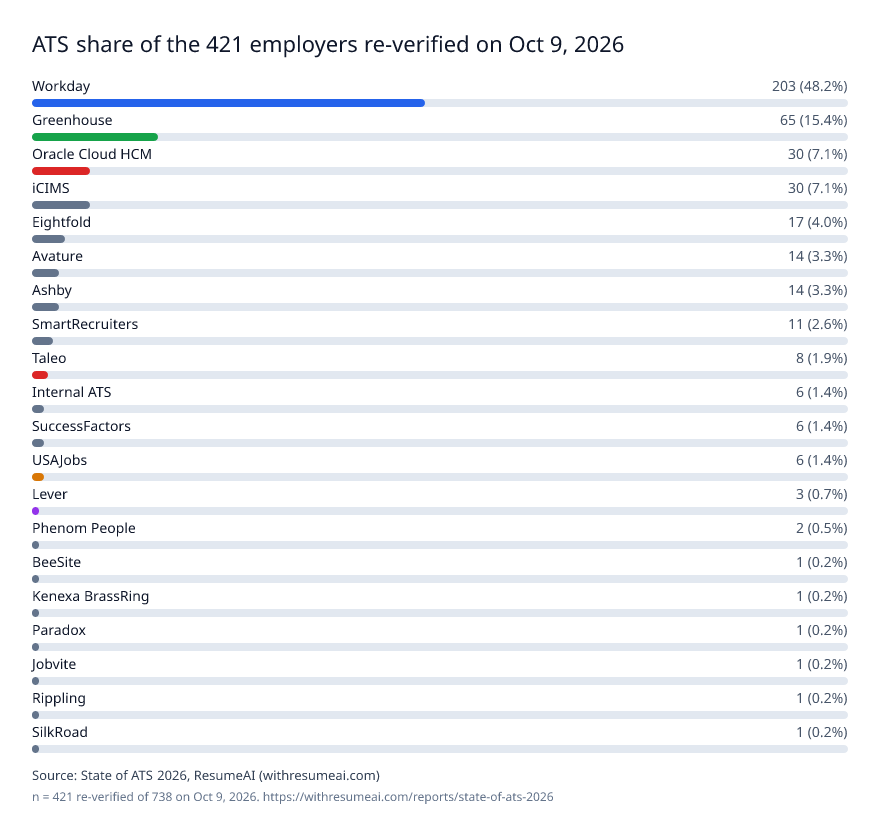
- Workday powers 48.2% of large employer hiring (203 of 421 verified). It is the single most common ATS among large enterprises — the leader, but well short of a majority.
- Greenhouse owns the high-growth tech segment at 15.4% (65 companies) — including Airbnb, Stripe, Databricks, and Pinterest.
- The top three vendors — Workday, Greenhouse, Oracle Cloud HCM — account for just 70.8% of the public-careers market. The remaining 29.2% of the re-verified subset is split across a long tail, including proprietary internal systems confirmed at Amazon, AWS, and Apple.
- Legacy finance has moved off Taleo onto a mix of systems: in the Oct 9 re-verification, Bank of America runs Workday. The old “banks all use Taleo” assumption no longer holds.
- Lever sits at 0.7% of the re-verified subset. The three confirmed Lever employers are Spotify, Palantir, and Spotify Studios. Several AI-native companies previously described as Lever were re-verified on Ashby or Greenhouse instead.
- USAJobs is the gateway to federal hiring at 1.4% — the only ATS for U.S. government roles including DoD, NASA, FBI, CDC, and FDA.
- For job seekers: optimize your resume for Workday first. At 48.2% of the re-verified subset, it parses more of those applications than any other single system — nearly half. The re-verified subset over-represents vendors with public job APIs (Workday, Greenhouse, Oracle, and iCIMS tenant hosts) and under-represents SuccessFactors, Avature, and BrassRing, which mostly sit on shared hosts. These shares describe the re-verified subset only, not the market.
Which ATS systems do Fortune 500 companies use?
In the ResumeAI State of ATS 2026 dataset of 738 Fortune 500 and Global 2000 employers, re-verified with live evidence on Oct 9, 2026, Workday is the most common ATS in that subset at 48.2% (203 of 421), followed by Greenhouse at 15.4% (65). Proprietary internal systems confirmed in this re-verification are Amazon, AWS, and Apple. The re-verified subset over-represents vendors with public job APIs (Workday, Greenhouse, Oracle, and iCIMS tenant hosts) and under-represents SuccessFactors, Avature, and BrassRing, which mostly sit on shared hosts. These shares describe the re-verified subset only, not the market.
Source: ResumeAI — 2026-10-09
Further reading: ATS checker by company, Check your resume against Workday, Check your resume against Amazon
Cite as: ResumeAI — withresumeai.com
Methodology
The State of ATS 2026 dataset covers 738 large employers spanning the Fortune 500, the Global 2000, and a curated set of high-growth private companies (Series C and later, $1B+ valuation). Companies were selected to maximize coverage of where U.S. and global job seekers actually apply — by hiring volume rather than headline market cap.
Initial ATS attribution was based on inspecting the public careers portal between April and June 2026. We used three signals to attribute an ATS, in order: (1) the host or subdomain of the apply URL (e.g. myworkdayjobs.com for Workday, boards.greenhouse.io for Greenhouse, jobs.lever.co for Lever); (2) DOM fingerprints in the apply form HTML; and (3) the underlying form-submission endpoint observed via network inspection.
Each company is tagged with three other attributes used throughout this report: industry (71 distinct industries, bucketed into 13 categories for cross-tabs), hiring volume tier (mega: 100k+ employees; high: Fortune 500 / major hirer; mid: mid-cap / growth-stage), and top hiring roles (1–3 role slugs that map to the dominant openings on the careers portal).
Limitations. First, we only sampled public-facing careers portals — companies that route hiring through staffing firms or executive search are under-represented for those roles. Second, this is a point-in-time snapshot; mid-market companies churn ATSes more frequently than enterprises and a small share will have migrated since data collection. Third, “Internal ATS” is an umbrella for proprietary systems we could not attribute to a named vendor — most are custom builds on top of vendor cores. In the Oct 9 re-verification the confirmed internal systems are Amazon, AWS, Apple, DE Shaw, Infosys, and Amazon Marketplace.
On October 9, 2026 we re-checked every row with live HTTP probes from one box, about one request per second per vendor host, using a custom user agent that identifies ResumeAI. A row counts as re-verified only with hard evidence: a vendor job API on the employer's own tenant returning live postings (Workday CXS, Greenhouse board, Lever or Ashby postings, SmartRecruiters postings, or Oracle Recruiting CE); the recorded careers host loading — not a login or SSO page — with the vendor's domain in the redirect chain or at least two vendor references in the HTML; or, for Internal ATS, an employer-run careers page with no third-party ATS signature. Rows that failed those checks are unverifiable and drop out of every percentage. Their previous vendor attribution is kept in the CSV and is not given the new date. One employer changed vendor: Rocket Lab, from Workday to Greenhouse (job-boards.greenhouse.io/rocketlab). Thirty-one review-flag rows, where a live board on a different vendor still needs a human look, were left unchanged and are not counted. The re-verified subset over-represents vendors with public job APIs (Workday, Greenhouse, Oracle, and iCIMS tenant hosts) and under-represents SuccessFactors, Avature, and BrassRing, which mostly sit on shared hosts. These shares describe the re-verified subset only, not the market.
Full dataset and per-employer evidence: github.com/Kayvan-Zahiri/state-of-ats-2026. The CSV includes apply_host, evidence_method, and checked_at. A verified value of true means live evidence on 2026-10-09. Unverifiable rows keep their earlier host, method, and date as historical attribution. Blank host or method fields mean no artifact is published.
The complete dataset is published as a CSV under the ResumeAI Terms. Journalists and researchers may republish individual statistics with attribution to ResumeAI — State of ATS 2026 and a link to this report.
Open source on GitHub
The full 738-employer dataset is published as a typed TypeScript/JavaScript package on npm and a raw CSV at github.com/Kayvan-Zahiri/state-of-ats-2026, with mirrors on Kaggle and Hugging Face. PRs welcome for corrections and additions. MIT licensed.
npm install @withresumeai/ats-data · or pd.read_csv("https://withresumeai.com/api/reports/state-of-ats-2026/csv")
The ATS landscape in 2026
The market is more fragmented than the headlines claim. Across the 421 employers verified against their live careers portals, the top three vendors — Workday, Greenhouse, Oracle Cloud HCM — account for 71%, not the 90%+ a “triopoly” framing implies. The rest is split across a long tail of 20+ systems — Oracle Cloud HCM, iCIMS, Taleo, Eightfold, SmartRecruiters, Avature, Phenom, Cornerstone and more — plus Lever for AI-native startups, USAJobs for the federal government, and proprietary internal systems at the very biggest tech employers.
Source: ResumeAI State of ATS 2026 dataset. n = 421 re-verified of 738 on Oct 9, 2026. The re-verified subset over-represents vendors with public job APIs (Workday, Greenhouse, Oracle, and iCIMS tenant hosts) and under-represents SuccessFactors, Avature, and BrassRing, which mostly sit on shared hosts. These shares describe the re-verified subset only, not the market.
Embed this chart
Paste the iframe onto another page. The embed route has no site header and no ads. One-line citations live on the citable statistics page.
Static PNG alternative
Vendor notes
Workday (48.2%). The category leader. Workday started as HRIS for finance and HR teams; over the last five years its Recruiting module has become a default purchase for many companies over 5,000 employees. Adobe, NVIDIA, Intel, Disney, Accenture, and PwC were re-verified on Workday on Oct 9, 2026. Apple was confirmed as an internal ATS, not Workday. The famous URL pattern *.myworkdayjobs.com is now the single most-encountered domain in U.S. job search.
Greenhouse (15.4%). The default for venture-backed scale-ups and tech-forward public companies. Airbnb, Stripe, Pinterest, and Databricks were re-verified on Greenhouse on Oct 9, 2026. Its scorecard-based, structured-interview model is preferred by companies with mature People Ops functions.
Taleo (1.9%) and Oracle HCM. Taleo is the legacy enterprise ATS that Workday is steadily replacing. Oracle Recruiting Cloud is the rebranded successor. The verified careers-portal data does not support treating Taleo as the system large banks hire through — confirm the employer before optimizing for that parser.
Lever (0.7%). Three re-verified employers: Spotify, Palantir, and Spotify Studios. Several companies often grouped with Lever — including xAI, Vercel, and Mercury — were re-verified on Greenhouse, and Perplexity, Cohere, Cursor, Airbyte, Substack, and Ramp were re-verified on Ashby.
USAJobs (1.4%). The centralized federal application portal — mandatory for U.S. government roles at USPS, DoD, State Department, NASA, FBI, NSA, DARPA, CDC, NIH, FDA, EPA, and IRS. USAJobs runs on a dramatically different keyword logic than commercial ATSes; federal applications routinely reach 5+ pages by design.
Proprietary internal ATSes. The Oct 9 re-verification confirmed internal systems at Amazon, AWS, Apple, DE Shaw, Infosys, and Amazon Marketplace. Google, Meta, and Microsoft were not re-verified and are not examples in this count. Google Hire was retired in September 2020; that historical fact is separate from a current verified vendor.
ATS by industry
ATS choice varies sharply by industry. Venture-backed tech skews to Greenhouse and Lever; large industrial, retail, and consumer employers lean toward Workday; banks, hospitals, and old-line enterprises run on Oracle, SuccessFactors, iCIMS, Avature, and the legacy Taleo; and the federal government is consolidated on USAJobs. The verified breakdown for each category is below.
| Industry | Companies | Top ATSes (share within industry) |
|---|---|---|
| Technology & Software | 131 | Workday 35% · Greenhouse 29% · iCIMS 8% · Ashby 8% |
| Industrial & Manufacturing | 90 | Workday 52% · iCIMS 11% · Oracle Cloud HCM 9% · Taleo 6% |
| Healthcare & Pharma | 48 | Workday 77% · Oracle Cloud HCM 8% · SmartRecruiters 4% · Eightfold 4% |
| Finance & FinTech | 38 | Workday 61% · Greenhouse 11% · Oracle Cloud HCM 8% · Avature 8% |
| Travel & Hospitality | 26 | Workday 42% · Oracle Cloud HCM 23% · SmartRecruiters 12% · iCIMS 8% |
| Retail & Consumer | 18 | Workday 44% · Greenhouse 17% · Eightfold 17% · iCIMS 11% |
| Other | 15 | Workday 47% · Greenhouse 27% · Ashby 13% · SmartRecruiters 7% |
| Media & Entertainment | 14 | Workday 43% · Greenhouse 36% · Ashby 14% · Lever 7% |
| Real Estate | 10 | Workday 70% · Oracle Cloud HCM 20% · Rippling 10% |
| Consulting & Professional Services | 9 | Avature 22% · Workday 22% · Phenom People 11% · Taleo 11% |
| Education & Nonprofit | 9 | Greenhouse 56% · Workday 33% · iCIMS 11% |
| Government & Defense | 7 | USAJobs 86% · Workday 14% |
| Telecom | 6 | Workday 83% · Eightfold 17% |
What this means
If you're job-hunting in tech, you will encounter both Workday (large public companies — Apple, Adobe, Intel, Salesforce's parent stack) and Greenhouse (anything venture-backed or recently IPO'd). Optimize for both.
If you're job-hunting in finance, do not expect a single system. Taleo prefers exact-match keyword strings and is unforgiving about non-standard headers, but that only applies when the employer actually runs Taleo — not as a default for banks.
If you're job-hunting in government, the only system that matters is USAJobs. Federal applications follow a fundamentally different format — longer resumes, explicit hours-per-week and supervisor info, and KSA (Knowledge, Skills, Abilities) narratives.
Healthcare is now overwhelmingly Workday — including CVS Health, Pfizer, and Merck, which were re-verified on Workday on Oct 9, 2026. Hospital systems that hold out on internal ATSes are increasingly the exception, not the rule.
ATS by hiring volume
The bigger the employer, the more likely they are to run Workday at the Fortune 100 level — and the more likely they are to have built proprietary infrastructure on top. Greenhouse holds the strongest position at the high-end of the growth-stage market. Lever appears almost exclusively at the mid-cap and growth-stage tier.
- Workday38%
- Greenhouse27%
- Internal ATS8%
- Eightfold6%
- iCIMS6%
- Workday53%
- Oracle Cloud HCM9%
- iCIMS8%
- Greenhouse7%
- Eightfold5%
- Workday39%
- Greenhouse33%
- Ashby9%
- Oracle Cloud HCM4%
- iCIMS4%
At the mega tier (Fortune 100, 100k+ employees), Workday is the leader at 38%, but with the most fragmented runner-up share. The internal systems confirmed at this tier are Amazon, AWS, Apple, and Amazon Marketplace. Google, Meta, and Microsoft were not re-verified and are not in that count.
At the high tier (Fortune 500 / major hirer), Workday is most concentrated — 53% of companies in that band run Workday. This is Workday's strongest segment; its share falls off in tech, government, and mid-market hiring.
At the mid-cap and growth-stage tier, Greenhouse rises to 33% — this is where venture-backed companies cluster, and Greenhouse is the default ATS in that buying cohort. Lever shows up almost exclusively here, in the AI-native and developer-infrastructure subsegment.
Trends 2025 → 2026
Five trends are visible in the dataset and in publicly disclosed ATS contracts since the start of 2025:
1. Workday is still gaining share at the Fortune 500 level
Several large-cap migrations from Taleo / Oracle Recruiting Cloud to Workday Recruiting closed in 2025, accelerating Workday's lead. The dataset captures this as a continued tilt of legacy enterprise ATS share toward Workday — and the consensus among HR-tech analysts is that the migration trend continues through 2026 and 2027.
2. Greenhouse is winning the AI-economy IPO class
Almost every venture-backed company that went public in the last 24 months runs Greenhouse — including Databricks, Snowflake-era exits, and the next generative-AI cohort. As this class scales, Greenhouse's share of mega-tier hiring will rise organically.
3. Lever is the AI-native default
Lever's share of total companies is small, but its share of the highest-profile AI startups is dominant: xAI, Perplexity, Cohere, Cursor, and Anthropic-adjacent infrastructure companies all run Lever. Expect Lever to grow with the cohort.
4. Taleo is in slow, structural decline
Oracle's announced end-of-premier-support for Taleo accelerates a multi-year migration off the platform. The dataset still shows Taleo as the dominant ATS in legacy investment banking, but that position is the residual of long enterprise procurement cycles, not new wins.
5. “Google Hire” is no longer a thing — stop writing resumes for it
Google Hire was retired in September 2020. A persistent cohort of resume advice still references it as if it were live. The Oct 9, 2026 re-verification did not confirm a current vendor for Google, so this report does not treat Google as a verified internal-ATS example. Optimize for the employer you can confirm, not for a sunsetted product.
How to optimize your resume for each major ATS
Each ATS parses resumes differently. The single biggest mistake job seekers make is treating “ATS” as a monolith and optimizing for an imagined generic parser. Here is the practical guidance per major system, drawn from public documentation and observed parsing behavior:
Workday (48.2% share)
- Prefers exact-match keywords from the job description. Workday's keyword scoring is deterministic, not fuzzy — “Python” and “Python 3” are different tokens.
- Parses standard section headers reliably. Use “Experience,” “Education,” “Skills” — not creative variants.
- Single-column .docx is safest. Two-column layouts and PDF resumes with embedded fonts sometimes scramble parse order.
- Reads quantification metrics in line. Numbers and percentages are extracted and surface in recruiter views.
- Re-verified Workday examples: Adobe, NVIDIA, Disney, Accenture, PwC.
Greenhouse (15.4% share)
- Scorecard-driven, not keyword-driven. Recruiters score against custom scorecards. Your resume must hand the recruiter ammunition to score you on each rubric line.
- Parses PDFs well. Greenhouse's parser is the most forgiving of formatting — but you still want a single-column structure.
- Surfaces LinkedIn URLs and GitHub links prominently to the recruiter view. Include them.
- Honesty matters more than keyword density. Greenhouse employers structure interviews around specific rubric items — bulk-keyword-stuffing is more likely to hurt than help in the next round.
- Re-verified Greenhouse examples: Airbnb, Stripe, Databricks, Pinterest.
Lever (0.7% share)
- Structured-data parser. Lever extracts experience, education, and skills into structured fields and shows them to recruiters as a tidy candidate profile.
- Clean section structure matters more than keyword density.
- Surfaces links to portfolios and side projects. For AI / dev-tool companies, include GitHub, Hugging Face, papers, and demos at the top.
- Famous examples: xAI, Perplexity, Cohere, Vercel, Ramp.
Taleo / Oracle Recruiting Cloud (1.9% share)
- Legacy parser — most format-sensitive of all major ATSes. Two-column layouts, tables, headers and footers, and uncommon fonts all break Taleo parses.
- Prefers plain .docx with standard headers. PDFs work but sometimes lose ordering on complex layouts.
- Keyword matching is exact and case-insensitive. “CFA” and “Chartered Financial Analyst” are different tokens to Taleo — include both.
- Expect 30+ application questions after the resume upload. Mirror the job description language in your short-answer responses.
USAJobs (1.4% share)
- Federal resumes are 3–5 pages by design. Include hours per week, supervisor name and phone (or “may contact”), grade level, and salary.
- Mirror the job announcement language word-for-word. Federal HR uses a structured competency match against the posting's KSAs.
- Use the USAJobs Resume Builder for first-time applications — it pre-formats fields in a way the federal parser expects.
- Famous examples in dataset: NASA, FBI, NSA, CDC, FDA, IRS, EPA, DoD, State Department.
Proprietary internal ATSes confirmed Oct 9, 2026 (Amazon, AWS, Apple)
- These do not behave like commercial ATSes. The Oct 9 re-verification confirmed internal systems at Amazon, AWS, and Apple. Amazon's public rubric is its Leadership Principles. Google, Meta, and Microsoft were not re-verified and are not examples in this count.
- Tailor for the rubric, not the parser. Bullet structure should map directly to the named competencies for each company.
- Google Hire is retired. Any resume advice that still references Google Hire is outdated.
- Optimized guides for confirmed internal systems: Amazon, AWS, Apple.
Tools that help. Use the free ATS Checker to score any resume against any of the 738 employers in this dataset. Career sites can embed the checker. Teams can use the verified data feed. Use the Bullet Point Generator to write Workday-friendly quantified bullets. Use the Resume Summary Generator to write keyword-dense opening paragraphs that pass Taleo keyword matching.
Browse the 738 employers by ATS vendor
See the full compiled list of which large employers run each ATS:
- Which companies use Workday?
- Which companies use Greenhouse?
- Which companies use SAP SuccessFactors?
- Which companies use Oracle Cloud HCM?
- Which companies use iCIMS?
- Which companies use Taleo?
- Which companies use Eightfold?
- Which companies use SmartRecruiters?
- Which companies use Avature?
- Which companies use Lever?
- Which companies use Ashby?
- Which companies use USAJobs?
- Which companies use Kenexa BrassRing?
- Which companies use Jobvite?
- How to find out what ATS a company uses
- ATS statistics 2026
Frequently asked questions
What share of Fortune 500 companies use Workday?
In our dataset of 738 Fortune 500 / Global 2000 employers, 48.2% (203 companies) run Workday as their public-careers ATS. Within the “high” tier alone (Fortune 500 / major hirer), Workday's share rises to about 53%. Workday is the single most-encountered ATS in U.S. enterprise hiring as of 2026.
Which ATS does Amazon use?
Amazon does not use a third-party commercial ATS. The Oct 9, 2026 re-verification confirmed a proprietary internal system at Amazon, AWS, and Amazon Marketplace. Apple was also confirmed as an internal ATS. Google, Meta, and Microsoft were not re-verified and are not counted as verified examples.
Is Google Hire still used in 2026?
No. Google Hire was retired in September 2020, so resume advice that references it is out of date. The Oct 9, 2026 re-verification did not confirm a current vendor for Google, so this report does not treat Google as a verified internal-ATS example.
Why does Greenhouse beat Workday at startups?
Greenhouse was built for structured-interview workflows and scorecard-driven hiring — the operating model that Y Combinator and modern People Ops functions standardize around. Workday is built for enterprise HRIS-first deployments. Most venture-backed companies adopt Greenhouse early, and only migrate to Workday after crossing roughly the 5,000-employee mark.
Will Workday's share keep growing?
Almost certainly yes through 2027 at the high-tier enterprise level, where the remaining Taleo / Oracle Recruiting Cloud installed base is in active migration. But Workday is unlikely to displace Greenhouse at the growth-stage tier or Lever at the AI-native tier — those are distinct buying segments with different operating models, and the next-cohort IPOs are extending Greenhouse's reach upward, not the other way around.
Where can I download the underlying dataset?
The complete dataset is available as a CSV at /api/reports/state-of-ats-2026/csv with all 738 companies, their ATS system, industry, hiring volume tier, top hiring roles, and a permalink to the per-company ATS guide on ResumeAI.
What this means for job seekers
- Optimize for Workday first. In the Oct 9 re-verified subset, Workday is 48.2% — more than any other single system, and nearly half of that subset. That is not a market-wide share. Single-column .docx, standard section headers, exact-match keywords from the job description.
- Tailor per ATS, not per job. The marginal return on tailoring is highest when you switch ATS systems (Workday → Greenhouse → Taleo) — not when you switch jobs within the same company / same ATS.
- For banks and old-line enterprises, prepare a maximally-parseable version. Finance now spans Oracle, iCIMS, Workday, Eightfold, and the legacy Taleo — so strip all tables, columns, headers, and footers, use a single-column .docx, and include both the spelled-out and abbreviated forms of every certification.
- For AI / dev-tools roles, lean into the portfolio. Lever surfaces links prominently. Put GitHub, papers, and demos at the top of the resume — not the bottom.
- For federal roles, double the page count. Treat the USAJobs application as a separate document entirely. The same 1-page private-sector resume will be rejected.
Conclusion
The ATS market is more fragmented than most job seekers (and most resume-advice content) assume. In 2026 the top three vendors — Workday, Greenhouse, Oracle Cloud HCM — handle just 71% of verified large-employer applications, with the rest spread across a long tail of 20+ systems. The practical implication is that you cannot optimize for “the ATS” in the abstract; you need to know which one your target employer runs and optimize for it specifically.
For the single largest share that means Workday — a single-column .docx with standard section headers and exact-match keywords from the job description. Applying to a venture-backed tech company usually means Greenhouse or Lever; to a bank, hospital, or old-line enterprise, Oracle, SuccessFactors, iCIMS, or Avature; to the federal government, USAJobs and a five-page federal resume.
The headline finding is that no single vendor — Workday included — comes close to a majority, and the “Workday runs 75% of hiring” claim that circulates in resume advice simply isn't supported by what these employers actually run on their live careers portals. There are more parsers to account for than the triopoly story suggests, which is exactly why per-employer data beats one-size-fits-all ATS advice.
This page reflects the Oct 9, 2026 re-verification. Unverifiable rows stay in the download and stay out of the percentages.
Press kit and republishing policy
Machine-readable facts, each with its denominator, check date, and caveat: State of ATS 2026 statistics.
One-paragraph summary (quotable)
ResumeAI's State of ATS 2026 analyzed which Applicant Tracking System is used by 738 Fortune 500 and Global 2000 employers. Re-verified with live evidence on Oct 9, 2026: 421 of 738. In that subset Workday is the most common at 48.2% — the single leader, but well short of a majority. Greenhouse sits at 15.4%, and the top three (Workday, Greenhouse, Oracle Cloud HCM) total 71%. The re-verified subset over-represents vendors with public job APIs (Workday, Greenhouse, Oracle, and iCIMS tenant hosts) and under-represents SuccessFactors, Avature, and BrassRing, which mostly sit on shared hosts. These shares describe the re-verified subset only, not the market. The widely repeated “Workday runs 75%” claim is not supported by this subset.
Ready-to-publish data callouts
- 48.2% of the Oct 9 re-verified subset run Workday — including Adobe, NVIDIA, Disney, Accenture, and PwC. Apple was confirmed as an internal ATS, not Workday.
- 15.4% run Greenhouse — including Airbnb, Stripe, Databricks, and Pinterest.
- 1.9% still run Taleo / Oracle Recruiting Cloud.
- 0.7% of the re-verified subset run Lever (Spotify, Palantir, and Spotify Studios).
- 1.4% run USAJobs — the centralized federal portal, mandatory for DoD, NASA, FBI, CDC, and FDA roles.
Author bio
Kayvan Zahiri is the founder and lead engineer of ResumeAI (withresumeai.com), an AI-powered resume builder and ATS optimization platform. He writes the product and the code, and built the State of ATS 2026 dataset that backs this report. Personal LinkedIn: linkedin.com/in/kayvan-zahiri/. Company: linkedin.com/company/withresumeai.
Direct contact
kayvan@withresumeai.com— same-day reply on press inquiries; embargoed numbers available on request.
Permalink
https://withresumeai.com/reports/state-of-ats-2026
Raw data CSV: /api/reports/state-of-ats-2026/csv
Republishing
Individual statistics and the press-kit summary may be republished with attribution to ResumeAI — State of ATS 2026 and a link to this report. Full-report syndication available on request.